📄Where to take a food tour in Seoul — Gwangjang, Namdaemun, Myeongdong, Euljiro and more. What defines each area, what to eat, and which suits your trip.
ℹ️Quick Answer
The best area for a Seoul food tour depends on what you want. Gwangjang Market is the essential first choice — Korea's oldest market and the classic street-food experience. Namdaemun is the largest and most local; Myeongdong offers the most variety but at tourist prices; Euljiro and Ikseon-dong are the top areas for night food and drinks; and Mangwon and Hongdae bring local, youthful energy. Most first-timers should start with Gwangjang, then choose a second area based on their taste.
Seoul's food scene is organized around neighborhoods, and each has a distinct character that shapes the kind of tour you'll have. The first decision is market versus neighborhood: traditional markets like Gwangjang and Namdaemun concentrate dozens of stalls in one dense, energetic space, while districts like Euljiro and Hongdae spread their food and drink across streets, alleys, and restored buildings. The second is day versus night — some areas peak at lunch, others only come alive after dark. And the third is tourist-famous versus local — the trade-off between iconic, easy-to-navigate spots and quieter, more authentic ones where locals actually eat.
There's no wrong choice, but there is a smart sequence. For a first food tour, the classic Gwangjang Market experience is the ideal introduction. From there, a second tour in a contrasting area — a night district for drinks and atmosphere, or a local market off the tourist trail — rounds out your picture of how Seoul really eats.
Area
Vibe
Signature Eats
Best For
Day / Night
🥇 Gwangjang Market
Iconic, energetic, oldest market
Bindaetteok, mayak gimbap, yukhoe
First-timers, the essential
Day (also night)
🏛️ Namdaemun Market
Largest, local, authentic
Braised spearfish, hotteok, kalguksu
Authenticity over fame
Day & night
✨ Myeongdong
Touristy, high-variety corridor
Tornado potato, egg bread, tteokbokki
Variety (mind the prices)
Late afternoon–night
🍺 Euljiro
"Hipjiro" — retro-hip bars & eats
Old-school Korean, craft beer
Night, drinks, trendy
Night
🏮 Ikseon-dong
Restored hanok lanes
Makgeolli, pajeon, café fare
Atmosphere, traditional drinks
Day & night
🌱 Mangwon Market
Local gem, off the trail
Viral snacks, mandu, hotteok
Local feel, value
Day
🎓 Hongdae
Young, trendy, late-night
KBBQ, tteokbokki, fusion snacks
Budget, nightlife energy
Evening onward
❓ What's the best neighborhood for a food tour in Seoul?
For most first-timers, Gwangjang Market is the best area to start — it's Korea's oldest market, the setting for the most iconic Seoul street-food experience, and the easiest introduction to Korean market food. From there, the best second choice depends on your taste: Namdaemun for a larger, more local market; Myeongdong for variety (though at higher tourist prices); Euljiro or Ikseon-dong for night food and drinks; and Mangwon or Hongdae for a young, local vibe. Most travelers do Gwangjang first, then pick a contrasting area.
Gwangjang Market: The Essential First Stop
If you take only one food tour in Seoul, make it Gwangjang. Opened in 1905, it's Korea's oldest permanent market, and its second-floor food alley became internationally famous through Netflix's Street Food: Asia. It's the beating heart of Seoul street food — a dense, energetic maze of stalls where the classics are at their best: bindaetteok (mung bean pancakes ground and fried to order), mayak gimbap (addictively good mini seaweed rolls), yukhoe (fresh Korean beef tartare), and hand-cut kalguksu noodles, including from vendors who've been perfecting the same dish for decades.
Gwangjang is central, easy to reach, and busiest at lunch, when office workers from the surrounding districts pack the alleys and the atmosphere peaks. That popularity is the only real downside — it gets crowded, and queues at the famous stalls can be long — but a good tour navigates it for you, steering you to the best versions of each dish. For a first taste of Korean market food, nothing else compares.
The trade-off: Gwangjang's fame means crowds and queues, especially at lunch and at the Netflix-famous stalls. But that energy is central to the experience, and it remains the single best introduction to Seoul street food — the area to prioritize if you only have time for one.
Namdaemun Market: The Largest and Most Local
For a market experience that feels more like everyday Seoul, Namdaemun is the pick. Sprawling beneath the historic Great South Gate, it's Korea's largest traditional market, with over 10,000 stalls, and many operate around the clock. Despite its size and central location, it retains a genuinely local feel — this is where Seoulites actually shop, eat, and gather, rather than a stop built for tourists. That authenticity is its appeal.
The food leans hearty and traditional: spicy braised spearfish (a Namdaemun specialty), hotteok (sweet syrup-filled pancakes), and kalguksu served under atmospheric canvas-tented alleys. Because it's less internationally famous than Gwangjang, a Namdaemun food tour tends to feel more discovery-driven and less crowded with fellow visitors. It's an excellent second tour, or a first choice for travelers who prioritize authenticity over icon-ticking.
The trade-off: Namdaemun lacks Gwangjang's headline fame and its sprawling scale can feel less curated, so it's less of an obvious "must-do." But that's exactly why it feels more local and less touristy — the better pick for travelers who want to eat where Seoulites actually do.
Myeongdong: Best for Variety, But Watch the Prices
Myeongdong is Seoul's most famous tourist street-food corridor, and its pedestrian streets transform into a wall of food stalls from late afternoon onward. The draw is variety and spectacle: tornado potatoes on skewers, gyeranppang (egg bread), grilled seafood, hotteok, tteokbokki, and an ever-changing lineup of Instagram-friendly snacks, all in a lively, easy-to-navigate, English-friendly setting. For first-timers who want to sample a wide range in one visit, it's undeniably fun.
Here's the honest caveat, though: Myeongdong stalls are frequently overpriced compared with identical food elsewhere, and locals will tell you the quality can be hit-or-miss. It's the tourist-district premium at work — you're paying for convenience and atmosphere, not value. Myeongdong is worth experiencing for its energy and variety, but it's not where you go for the best or cheapest version of any given dish. Treat it as street-food theater rather than the benchmark for Korean food.
The trade-off: Myeongdong offers unmatched variety and a tourist-friendly, high-energy atmosphere, but at inflated prices and inconsistent quality. It's worth a visit for the spectacle — just don't judge Korean street food by it, and head to a market like Gwangjang or Mangwon for the real thing.
❓ Is Myeongdong good for street food?
Myeongdong is fun for variety and atmosphere — its streets fill with food stalls from late afternoon, offering everything from tornado potatoes to egg bread in an easy, English-friendly setting. But be aware that Myeongdong stalls are often overpriced compared with identical food elsewhere, and the quality can be inconsistent, since it's a heavily touristed district. It's worth experiencing for the spectacle and variety, but for the best and most affordable Korean street food, a traditional market like Gwangjang, Namdaemun, or Mangwon is the better choice.
Euljiro and Ikseon-dong: The Best Areas for Night Food and Drinks
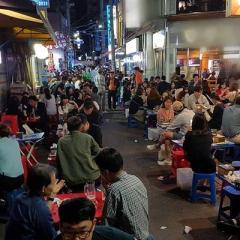
When the sun goes down, Seoul's food scene shifts to these two atmospheric districts. Euljiro — an old industrial and printing district nicknamed "Hipjiro" for its transformation into one of the city's trendiest zones — mixes old-school Korean eateries with retro bars, craft-beer taprooms, and hidden restaurants tucked between hardware shops. It's the place for a nostalgic-meets-hip evening of Korean comfort food and drinks. Ikseon-dong, by contrast, is a warren of restored hanok (traditional house) lanes now filled with charming restaurants, cafés, and traditional bars serving makgeolli (milky rice wine), often paired with savory pajeon (scallion pancakes).
Together, these areas are the heart of a Seoul night food tour, especially one built around the country's drinking culture — soju, makgeolli, and the rituals that go with them. Evening tours here combine great food with atmosphere: glowing alleys, traditional architecture, and the convivial energy of Seoul after dark. For travelers who want drinks and ambiance alongside their food, this is the zone.
The trade-off: These districts shine at night and revolve around drinking culture, so they're less suited to families or non-drinkers and don't offer much for a daytime market visit. But for atmosphere, traditional bars, and Seoul's after-dark energy, no daytime market can match them.
❓ Where's the best area for night food and drinks in Seoul?
Euljiro and Ikseon-dong are the top areas for a night food-and-drink tour. Euljiro (nicknamed "Hipjiro") pairs old-school Korean eateries with trendy retro bars and craft-beer taprooms, while Ikseon-dong offers restored traditional hanok lanes filled with charming restaurants and makgeolli (rice wine) bars. Both come alive after dark and are ideal for tours built around Korean drinking culture — soju, makgeolli, and the food that goes with them. Gwangjang Market at night is another strong option, combining street food with an evening market atmosphere.
Mangwon and Hongdae: Local Gems and Young Energy
For a taste of where young Seoul actually eats, these neighboring western districts deliver. Mangwon Market is a local favorite that most tourists never reach — a working neighborhood market where young residents shop, known for viral creative street food and second-generation vendors who've elevated their craft. Expect fresh mandu, hotteok, and seasonal specialties, often at better prices than the tourist markets, with a relaxed, genuinely local feel. It pairs perfectly with a stroll along the nearby Han River.
Hongdae, the area around Hongik University, has one of Seoul's most diverse and energetic eating scenes — Korean BBQ, late-night tteokbokki stalls, fusion snacks, and craft-beer bars, all skewing young, trendy, and budget-friendly. It's best from evening onward and constantly evolving as new spots open. Between them, Mangwon offers the authentic local-market experience and Hongdae the youthful, late-night energy — both excellent choices for travelers who want to escape the tourist trail and eat like Seoul's under-30s.
The trade-off: Mangwon and Hongdae are less iconic and a bit further from the central sights, so they require a little more intent to reach. But that's the point — they trade tourist fame for authenticity and value, making them ideal for a second tour or for travelers who want the local, contemporary side of Seoul's food scene.
Neighborhood characters, signature dishes, and market details reflect current 2026 information and can change — market hours, stalls, and prices vary, and areas evolve over time. Confirm specific market hours and tour meeting points before your visit. Prices at tourist-district stalls (such as Myeongdong) are often higher than at traditional markets.
About the Author
Intercoper Curator Team
Travel Analysts
Our team researches and curates tour experiences. We combine local knowledge with rigorous verification to recommend only tours worth your time.



 Gwangjang & Ikseon-dong 12+ Tasting Food Walk$88
 Kwangjang & Euljiro Alley Eat-and-Drink Crawl$85
 Mangwon Neighborhood Food Walk, 8 Tastings$85