Tipping in Korea: The Short Answer Is Don't
If you take one thing from this guide, make it this: Korea does not have a tipping culture, and in most situations you should not tip. At restaurants, cafés, taxis, hotels, and food stalls, tipping isn't expected and can actually cause confusion — leave money on a table and staff may chase you down thinking you forgot your change. Service is not underpaid the way it is in tipping economies, and since 2013 menus must show the final price, with tax and any service charge (봉사료, bongsaryo) already included, so nothing is added to the bill. Tipping can even backfire socially: offering a tip to a restaurant owner or an older person can unintentionally imply you see them as a servant rather than a professional.
There is one exception worth knowing for a food tour:
a private guide. Guides who work with international travelers generally won't refuse a tip, and after an excellent
private tour a gratuity is a kind gesture — though still entirely optional and never expected. If you'd like to, around
₩20,000 for a half or full day is meaningful without being awkward. The way you give it matters more than the amount: place the cash in a small envelope (sold at any convenience store) and hand it over with both hands, which signals a deliberate thank-you rather than forgotten change. In every other situation, the best "tip" is simply saying thank you —
"jal meogeosseumnida" (잘 먹었습니다, "I ate well") with a slight bow means far more than money.
❓ Do you tip on a Seoul food tour or in Korea generally?
No — Korea has no tipping culture, and you shouldn't tip at restaurants, cafés, taxis, or food stalls, where it can cause confusion or even come across as rude. Tax and any service charge are already included in the menu price, as Korean rules have required since 2013. The one exception is a private tour guide, where a tip is optional and appreciated but never expected — around ₩20,000 for a day, given discreetly in an envelope with both hands. On a group tour or at markets, no tip is needed. A sincere thank-you with a small bow is the genuinely appropriate gesture.
Essential Dining Etiquette
Korean dining customs flow from a deep cultural respect for elders and hierarchy, and a few simple habits will help you eat like a local rather than a tourist. The most important rules are easy to remember: wait for the eldest person at the table to begin eating before you start; never stick your chopsticks upright in a bowl of rice, as it resembles incense at a funeral and is considered very bad luck (rest them flat on a chopstick holder or the edge of your bowl instead); and use a spoon for rice and soup, chopsticks for side dishes. Unlike in Japan or China, you should keep your rice and soup bowls on the table rather than lifting them.
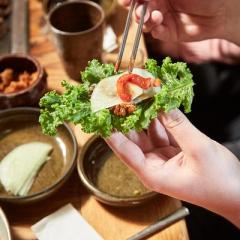
Above all, remember the two-handed rule — the single most impactful etiquette habit you can build in Korea. Give and receive everything with two hands: dishes, drinks, money, a business card, your change. Koreans notice and appreciate it immediately. A few smaller notes round it out: don't rub disposable chopsticks together (it implies the restaurant gave you cheap ones), don't touch food with your fingers (except when wrapping meat in lettuce), and while your rice is yours alone, side dishes are shared. That said, Korea is more relaxed about table formality than its neighbors — you can eat dishes in any order and assemble your lettuce wraps however you like. The effort to respect the big rules matters far more than perfection.
| ✅ Do | ❌ Don't |
|---|
| Wait for the eldest to start eating | Start before your elders |
| Rest chopsticks flat on a holder or bowl edge | Stand chopsticks upright in rice (funeral symbol) |
| Use a spoon for rice and soup | Lift your rice or soup bowl off the table |
| Give and receive everything with two hands | Hand over money or dishes with one hand |
| Pour drinks for others first | Pour your own glass before others' |
| Say thanks — "jal meogeosseumnida" | Leave a tip expecting it's welcome |
❓ What are the main Korean dining etiquette rules?
The key rules: wait for the eldest person to start eating before you begin; never stick chopsticks upright in a bowl of rice (it symbolizes a funeral rite); use a spoon for rice and soup and chopsticks for side dishes; and keep your rice and soup bowls on the table rather than lifting them. Most importantly, give and receive everything — dishes, drinks, money — with two hands, the single most appreciated gesture in Korea. Don't rub disposable chopsticks together or touch food with your fingers (except for lettuce wraps). Korea is fairly relaxed about formality, so effort matters more than perfection.
Korean Drinking Etiquette
Since many food tours — especially evening ones — involve soju,
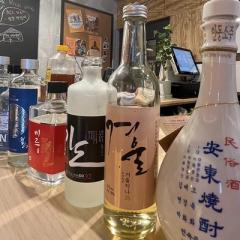
makgeolli, or beer, a little drinking etiquette goes a long way, because Korean drinking culture has its own graceful rules rooted in respect. The golden rule is that
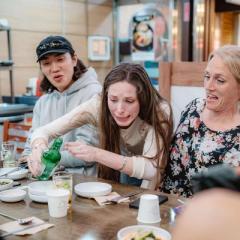
you pour for others, not for yourself — keep an eye on your companions' glasses and refill them before topping up your own, and someone will do the same for you. When you pour for someone, especially an elder,
hold the bottle with two hands (older Koreans may also rest one hand lightly on their chest). When someone pours for you,
receive the glass with both hands.One more traditional touch: when drinking alongside someone significantly older than you, it's polite to turn your head slightly away as you take your sip. And if you don't drink or want to slow down, that's completely fine — a simple "sul mot mashyeoyo" (술 못 마셔요, "I can't drink alcohol") is well understood, and hosts will happily offer you soda or water instead. You don't need to drain your glass each round; keeping it partly full is the gentle way to signal you've had enough without refusals.
The trade-off: These customs take a moment of attention that casual drinking at home wouldn't. But observing them — pouring for others, using two hands, the small bow of turning away — transforms how locals and guides receive you, turning a drink into a genuine gesture of connection rather than just a beverage.
Cash, Cards, and Paying
Korea is nearly a cashless society in 2026, and cards work almost everywhere — but there's one crucial exception for food lovers:
traditional markets and older street-food stalls are frequently cash-only. For any market day, including a food tour through
Gwangjang or Namdaemun, carry
₩30,000–50,000 in cash in small bills, which makes transactions easy for fast-moving vendors. If you run short, ATMs are available at every convenience store and inside the major markets. Small denominations matter — trying to pay for a ₩3,000 snack with a ₩50,000 note slows everyone down.
A couple of payment customs are worth knowing for restaurants (as opposed to stalls). In many Korean restaurants you pay at a counter near the entrance rather than waiting for the bill at your table, so don't be surprised when no one brings a check. If you need to get a server's attention, a polite "jeogiyo" (저기요, "excuse me") or the call button on your table is completely normal and not considered rude. And when handing over cash or a card, the two-handed rule applies here too — presenting payment with both hands is a small courtesy that's noticed.
❓ Do I need cash for a Seoul food tour, or can I use a card?
You'll want cash. While Korea is largely cashless and cards work in most restaurants and shops, traditional markets and older street-food stalls — exactly where food tours go — are frequently cash-only. Bring ₩30,000–50,000 in small bills for a market day; ATMs are available at every convenience store and inside major markets if you run short. Small denominations are best, since vendors move fast and may struggle to change a large note for a cheap snack. In restaurants you'll usually pay at a counter near the entrance rather than at your table, and it's polite to hand over payment with both hands.
What to Bring on a Seoul Food Tour
A little preparation makes a food tour far more comfortable. The essentials start with
cash in small bills (₩30,000–50,000, as above) and
comfortable walking shoes — tours cover a lot of ground on foot, and slip-on shoes are ideal since you may need to remove them at a traditional restaurant or a cooking-class studio. Come with
an empty stomach; a good tour delivers far more food than people expect, and arriving full is the most common regret. A small
reusable or tote bag is handy too, especially for a
cooking class where you may leave with leftovers, a recipe book, or a jar of kimchi.
Round out your kit based on the season and format. Dress for the weather in layers — winter (November to February) is peak street-food season but genuinely cold, while summer is hot and humid — and bring a small pack of tissues or hand wipes, since market stalls don't always offer napkins. A translation app on your phone smooths any ordering hiccups, though pointing works fine. Finally, a few basic Korean phrases go a surprisingly long way: annyeonghaseyo (hello), gamsahamnida (thank you), and juseyo (please give me) are all warmly received, and the effort to use them is genuinely appreciated.
| Item | Why |
|---|
| 💵 Cash, small bills (₩30,000–50,000) | Markets and street stalls are often cash-only |
| 👟 Comfortable slip-on shoes | Lots of walking; easy to remove where required |
| 🍽️ An empty stomach | Tours serve far more food than you expect |
| 👜 Small reusable / tote bag | For leftovers, a recipe book, or take-home kimchi |
| 🧥 Weather-appropriate layers | Winter is cold; summer hot and humid |
| 🧻 Tissues or hand wipes | Stalls don't always provide napkins |
| 📱 Translation app + basic phrases | Smooths ordering (though pointing works) |
The trade-off: Packing a few extras and carrying cash takes a moment of forethought that showing up empty-handed wouldn't. But the difference on the day is real — comfortable feet, easy payments, and room for all the food — which is what lets you focus on the experience rather than scrambling for an ATM or regretting that big breakfast.
Etiquette norms, tipping customs, and payment practices reflect current 2026 information and general cultural guidance — customs vary by situation and generation, and younger Koreans may be more relaxed about some traditions. Korea is largely cashless, but carry cash for markets. Tipping is not customary; a private guide is the main exception. Confirm current market hours and what a specific tour provides before your visit.



 Insadong Night BBQ & Rice Wine Food Crawl$110
 Jongno Market Street Food Walk with Drinking Games$79
 Hands-On Soju & Makgeolli Class in Mapo-gu$76.57