📄Seoul food tour prices by type — group, private, and night tours — plus how they compare to eating at the markets yourself, and what you're paying for.
ℹ️Quick Answer
Seoul food tours generally cost from around $29 for a basic group tour, with most small-group tours in the $49–110 range. Private tours typically cost $150–300+ for three to four hours. By comparison, eating the same street food yourself at a market like Gwangjang runs about $2–7 per dish, or $20–30 for a full meal. The gap isn't the food — it's the guide, translation, vendor knowledge, and curated route. Prices vary by season and operator, so always confirm before booking.
How Much Does a Seoul Food Tour Cost? The Price Ranges
Seoul food tour prices depend almost entirely on the format, and the range is wide. At the affordable end, a group market tour starts around $29, with most small-group tours falling in the $49 to $110 range depending on the number of tastings and the level of curation. Step up to a half-day tour packing in more dishes, drinks, or landmarks, and prices typically run $85 to $130. Night food-and-drink tours, which usually include alcohol, tend to land in the $70 to $100 range.
At the premium end, private tours generally cost $150 to $300 or more for a three-to-four-hour experience, scaling with guide expertise, group size, and customization. The important thing to understand is that these prices reflect the format, not the food — a $90 small-group tour and a $250 private tour might visit similar stalls and serve similar dishes; what differs is the group size, the personalization, and the pace. Match the format to your budget and priorities, and the price makes sense.
Tour Type
Typical Price
Duration
What You Get
💰 Budget group tour
From ~$29
2.5–3 hrs
Market classics, shared group
🍜 Small-group tour
~$49–110
2.5–3.5 hrs
More tastings, smaller group
🍽️ Half-day tour
~$85–130
4–5 hrs
8–12+ dishes, often a meal/landmarks
🌙 Night food & drink tour
~$70–100
3–4 hrs
Market food + soju/makgeolli
👤 Private tour
~$150–300+
3–4 hrs
Fully customized, your group only
Prices are approximate, reflect 2026 listings, and vary by operator, season, and demand. Always confirm the current price before booking.
❓ How much does a Seoul food tour cost?
Prices depend on the format. Group market tours start around $29, with most small-group tours in the $49–110 range. Half-day tours with more tastings and inclusions typically run $85–130, and night food-and-drink tours around $70–100. Private tours generally cost $150–300+ for three to four hours, depending on customization and group size. By comparison, eating the same street food yourself costs roughly $2–7 per dish. Prices vary by season, operator, and demand, so always confirm the current rate on the booking platform before you reserve.
What You're Actually Paying For
Given that Seoul's street food is famously cheap, it's fair to ask why a tour costs what it does. The answer is that you're not really paying for the food — you're paying for everything around it that turns a chaotic market into a smooth, rewarding meal. A good tour buys you structured routing (a curated sequence of stalls instead of wandering and guessing), local expertise (a guide who knows which vendors are excellent and which are overpriced tourist traps), and translation (menus at traditional stalls are often Korean-only and inconsistent).
It also buys vendor filtering and access — the guide has vetted the stalls in advance, so you skip the mediocre ones and eat the best versions of each dish, sometimes at places you'd never have found or felt confident ordering from alone. And it buys pacing and cultural context: the right amount of food in the right order, with the stories and customs that make the meal make sense. For a first-time visitor facing a language barrier and forty-minute queues at the famous stalls, that curation is the entire value proposition. The food is almost incidental.
The trade-off: You're paying a premium over the raw cost of the food for knowledge, translation, and curation. For a confident, adventurous eater who's researched the market, that premium may not be worth it — but for most first-timers, it's the difference between an efficient, memorable meal and a stressful hour of pointing at menus and hoping.
Tour vs Doing It Yourself: The Cost Comparison
The cheapest way to eat at a Seoul market is, without question, to go yourself. Street food is genuinely inexpensive: individual dishes at markets like Gwangjang and Namdaemun typically run $2 to $7 each, and a full, filling meal of several dishes comes to roughly $20 to $30 per person. A whole evening of grazing across a market can stay under about $25. So on pure food cost, DIY wins easily — a group tour costs several times what the same dishes would cost you directly.
But the comparison isn't quite like-for-like. The tour price bundles in the guide, translation, vendor knowledge, and route — value that doesn't show up on a per-dish basis but genuinely changes the experience, especially on a first visit. A useful way to frame it: if you're comparing purely on food cost, DIY is far cheaper; if you're valuing your time, your confidence navigating a language barrier, and the risk of eating at the wrong stalls, the tour's premium starts to look reasonable.
Dish
Typical Price (per portion)
Eomuk (fish cake skewer, "odeng")
~$1–2
Gimbap / mayak gimbap
~$2–3.50
Bindaetteok (mung bean pancake)
~$3–5
Mandu (dumplings)
~$4–5.50
Kalguksu (knife-cut noodles)
~$5.50–7
Full DIY market meal
~$20–30 per person
Approximate USD equivalents at roughly ₩1,400 to the dollar (2025–2026); prices vary by stall and location. Traditional stalls are typically cash-only.
❓ Is it cheaper to do a Seoul food tour yourself?
Yes, considerably. Eating at markets like Gwangjang yourself costs about $2–7 per dish, or roughly $20–30 for a full meal — several times cheaper than a guided group tour. If your only measure is food cost, DIY wins clearly. What a tour adds for its higher price is the guide, translation (many stall menus are Korean-only), vendor knowledge to skip the tourist traps, and a curated route. So DIY is cheaper, but a tour buys curation and confidence — most valuable on a first visit or if you're nervous about the language barrier.
Hidden Costs and Budgeting Tips
A few cost details are worth knowing so your budget matches reality. First, check what's included in the tour price — most cover all listed food tastings and often drinks, but transport to the meeting point is usually your own cost, and some tours include a sit-down meal while others are pure grazing. Second, most traditional market stalls are cash-only, so if you're eating independently or a tour has optional extra purchases, carry Korean won; ATMs are available inside both Gwangjang and Namdaemun markets.
A budgeting note that saves money and disappointment: stalls in tourist-heavy districts like Myeongdong often charge significantly more than identical food at Gwangjang or in residential areas, so Myeongdong is not where you want to benchmark "cheap street food." And one welcome saving — tipping is not customary in South Korea, and it's generally not expected on food tours, so you don't need to budget for it (though a genuinely great private guide won't refuse a token of thanks). Building in a small buffer for cash extras and transport keeps the day stress-free.
The trade-off: Booking the cheapest tour and hoping it covers everything can lead to surprise costs. Reading the inclusions carefully and carrying some cash takes a little planning, but it means the price you budgeted is the price you actually pay — no scrambling for an ATM mid-market or discovering lunch wasn't included.
How to Get the Best Value
Getting the most for your money comes down to a few simple moves. Look for a group tour with a high number of tastings relative to its price — a tour serving ten-plus dishes for $70 is better value than one serving five for $60. For budget travelers, a group tour almost always beats a private one on cost per person, unless you're a party of four or more, at which point a private tour's per-head price can become competitive. And because the same or similar tour can be priced differently across booking platforms, a quick cross-check between a global platform and an Asia-native one can surface a better deal.
Beyond that, consider timing and format. Tours can be pricier during peak seasons (cherry blossom season in early April, and major holidays), so booking outside those windows can help. And be honest about what you need: if you're a confident eater on a tight budget, a shorter, cheaper introductory tour to learn the ropes on day one — then DIY for the rest of the trip — can be the smartest spend of all.
The trade-off: Chasing the absolute lowest price can mean fewer tastings, a larger group, or a less experienced guide. The best value isn't the cheapest tour — it's the one that delivers the most tastings, the best guide, and the right format for your budget, which is usually a well-reviewed group tour rather than the rock-bottom option.
❓ What's included in a Seoul food tour price?
Most Seoul food tours include all the listed food tastings and often some drinks, plus your guide and the curated route. What's frequently not included: transport to and from the meeting point (usually your own cost), and any extra food or drinks you buy beyond the set tastings. Some tours include a sit-down meal while others are pure market grazing, so read the inclusions carefully. Tipping isn't customary in South Korea and generally isn't expected. Always check the specific listing to see exactly what the price covers before booking.
Tour prices, street-food prices, and inclusions reflect current 2026 information and can change — all figures are approximate ranges that vary by operator, season, demand, and exchange rate (around ₩1,400 per USD). Always confirm the current price and exactly what's included directly with the operator or booking platform before reserving.
About the Author
Intercoper Curator Team
Travel Analysts
Our team researches and curates tour experiences. We combine local knowledge with rigorous verification to recommend only tours worth your time.



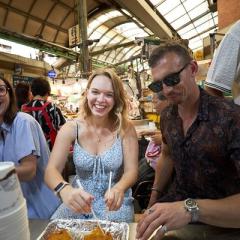 Bukchon, Palace & Gwangjang Market Feast$29
 Han River Night Cruise & Gwangjang Market Walk$59
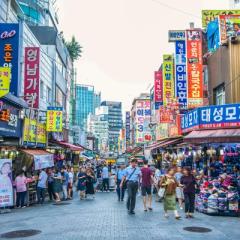 Namdaemun Market 7-Tasting Street Food Walk$47