How Much Does Food Cost in Seoul? Daily Budgets, Dish by Dish

Intercoper Curator Team

Travel Analysts

📄Seoul food prices from the official consumer survey: gimbap, kalguksu, bibimbap, naengmyeon and samgyetang, and what a day of eating costs.
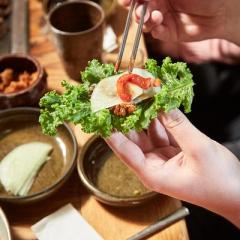
A plate of small seaweed rice rolls with carrot and pickled radish, sprinkled with sesame, held over a steel table with a dish of raw beef topped with an egg yolk and bowls of mustard sauce
ℹ️Quick Answer

A day of eating in Seoul costs roughly ₩20,000–30,000 on a lean budget, ₩30,000–50,000 eating the way office workers do, and ₩50,000–70,000 with a barbecue dinner. The official consumer survey puts the average Seoul price of a gimbap roll at about ₩3,900, kimchi stew with rice at ₩8,700, kalguksu at ₩10,000, bibimbap at ₩11,800, naengmyeon at ₩12,700 and samgyetang at ₩18,200. Menu prices include tax, and there is no tipping.

Explore the full guide & expert tips ➜

Seoul Food Prices: The Official Averages

Most answers to what food costs in Seoul are somebody’s receipts. There is a better source. The Korea Consumer Agency surveys restaurant prices every month and publishes the average for eight everyday dishes, city by city. These are the Seoul figures as its price portal showed them in October 2026.
🍽️ DishAverage price in SeoulWhat it is
🍙 Gimbap, one rollabout ₩3,900Seaweed rice roll; the cheapest sit-down meal
🍜 Jajangmyeonabout ₩7,700Noodles in black bean sauce
🍲 Kimchi-jjigae with riceabout ₩8,700Kimchi stew set, the standard lunch
🥢 Kalguksuabout ₩10,000Knife-cut noodle soup
🥗 Bibimbapabout ₩11,800Rice with vegetables, mixed at the table
❄️ Naengmyeonabout ₩12,700Cold buckwheat noodles
🐔 Samgyetangabout ₩18,200Whole young chicken in ginseng broth
🥓 Samgyeopsal, one portion as soldabout ₩18,200 (₩21,300 per 200 g)Pork belly for the grill; two-portion minimum
Read as a ladder, the table tells you how a Seoul lunch is priced. A roll of gimbap is under ₩4,000 and a stew with rice is under ₩9,000. The bowls that visitors seek out, bibimbap and cold noodles, sit a step higher at ₩11,000 to ₩13,000. Ginseng chicken soup is the most expensive single bowl on the list.
Two notes on reading it. These are averages, so a famous restaurant charges more: well-known cold-noodle houses in Seoul were reported in 2026 at ₩15,000 to ₩18,000 a bowl. And Seoul is the top of the range. The national average for the same bowl of naengmyeon is nearly ₩2,000 lower.

❓ How much is a meal in Seoul?

An everyday sit-down meal in Seoul costs about ₩8,000 to ₩13,000. The official consumer survey puts the Seoul average at about ₩8,700 for kimchi stew with rice, ₩10,000 for kalguksu, ₩11,800 for bibimbap and ₩12,700 for naengmyeon. A roll of gimbap is about ₩3,900. Famous restaurants charge more than the average.

The trade-off: an average is the honest number and the least useful one on the day. It tells you what the city charges, not what the restaurant in front of you does.

The Cheap End: Convenience Stores, Gimbap and Market Stalls

Below the restaurant ladder there is another one, and it is where a tight budget lives. Convenience stores sell rice triangles, lunch boxes and instant noodles with a hot-water tap and a counter to eat at. Gimbap shops sell a roll as a meal. Markets sell food by the piece.
🪙 The cheap endTypical range
🏪 Convenience-store triangle gimbapabout ₩1,200–1,700
🍱 Convenience-store lunch boxabout ₩4,300–5,500
🍢 One street-food item at a marketabout ₩2,000–6,000
🌶️ Tteokbokki, a plateabout ₩4,000–6,000; ₩5,000–7,000 in Myeongdong
🥞 Hotteokabout ₩2,000–3,000
☕ Americano at a budget coffee chainabout ₩1,700–2,000
☕ Americano at a large café chainabout ₩4,500–5,000
Street food is priced by the item, and most items fall between ₩2,000 and ₩6,000. Where you buy matters as much as what. The same plate of tteokbokki costs more on the food street in Myeongdong, a district built around visitors, than it does at a market.
Coffee is the line that surprises people. A budget chain sells an Americano for under ₩2,000; a large café chain charges more than twice that, which is more than a roll of gimbap.

❓ How much is street food in Seoul?

Most street-food items in Seoul cost about ₩2,000 to ₩6,000 each. A plate of tteokbokki runs about ₩4,000 to ₩6,000 and a hotteok about ₩2,000 to ₩3,000. Prices are higher in Myeongdong, where the same tteokbokki is commonly ₩5,000 to ₩7,000. Three or four items make a meal.

The trade-off: the cheap end is cheap per item, and a meal built from stalls adds up. Four things at ₩4,000 is a restaurant lunch with a stew, rice and side dishes included.

What a Day of Eating Costs: Three Budgets

Putting the two ladders together gives three realistic days. The figures are our arithmetic from the prices above, for one person, without alcohol except where noted.
📅 The dayWhat you eatRoughly
🟢 LeanConvenience-store breakfast, an everyday lunch, market stalls for dinner, one cheap coffee₩20,000–30,000
🟡 OrdinaryCoffee and a pastry, bibimbap or naengmyeon for lunch, a stew or noodles with a drink for dinner, an afternoon café₩30,000–50,000
🔴 With barbecueA light breakfast, a sit-down lunch, pork belly and drinks for dinner₩50,000–70,000
The middle row is the one to plan around. ₩30,000 to ₩50,000 a day buys three proper meals and a café stop. The lean row is entirely possible and leaves out sitting down for dinner. The top row is one barbecue meal away from the middle one: pork belly with drinks is the item that moves a day’s total more than any other.

❓ How much should I budget for food per day in Seoul?

Plan on about ₩30,000 to ₩50,000 per person per day for three ordinary meals and a coffee. A lean day built on convenience stores, gimbap and market stalls can come in at ₩20,000 to ₩30,000. A day with a Korean barbecue dinner and drinks runs about ₩50,000 to ₩70,000. Premium beef or a tasting menu sits well above all three.

The trade-off: a daily number hides the shape of the spending. Seoul lets you eat very cheaply at noon and very well at night, and most visitors are happier doing that than spreading the money evenly.

What the Menu Price Includes: Tax, Service and Side Dishes

The price on a Korean menu is the price you pay. Since 2013 restaurants have been required to show final prices, with tax and any service charge already included, and there is no tipping. Nothing is added at the counter.
More comes with that price than a visitor expects. The small side dishes called banchan arrive with most meals at no charge and are refilled on request, and water is free, often self-service. A ₩9,000 stew is a stew, a bowl of rice and three or four side dishes.
Payment is by card almost everywhere, with one exception worth planning for: older market stalls and street vendors often want cash.

❓ Is tax included in menu prices in Korea?

Yes. Restaurants in Korea have been required since 2013 to display final prices, with value-added tax and any service charge already included, so the menu price is what you pay. There is no tipping. Side dishes and water come free with most meals.

The trade-off: the all-in price makes Seoul easy to budget and easy to underestimate. With nothing added at the end, the only way a day goes over is by ordering more, and the food makes that likely.

Where the Money Goes Up: Barbecue, Beef, Cafés and Myeongdong

Four things push a food budget past the averages. The first is barbecue. Pork belly averages about ₩18,200 a portion as sold, most restaurants require two portions per table, and a dinner for two with a stew and drinks reaches ₩50,000 to ₩80,000.
The second is beef. Hanwoo, the domestic breed, starts at about ₩40,000 for a small portion and climbs steeply. The third is cafés: at a large chain, two coffees a day cost more than a lunch.
The fourth is location. Street food in the districts built around visitors is priced for visitors. The same snacks cost less at the traditional markets and in residential neighborhoods.

❓ Is food expensive in Seoul?

Everyday food in Seoul is moderately priced: about ₩8,000 to ₩13,000 for a sit-down meal, with tax included and no tipping. What costs more is barbecue, at roughly ₩25,000 to ₩40,000 per person, premium hanwoo beef, café coffee at about ₩4,500 to ₩5,000 a cup, and street food in visitor districts such as Myeongdong.

The trade-off: the expensive items are also the ones people come for. A budget that cuts barbecue and cafés is easy to keep and leaves out a good part of how Seoul eats.
Prices reflect information checked in October 2026. Dish averages are the Korea Consumer Agency’s published figures for Seoul and are averages, not menu prices; convenience-store, street-food and coffee prices are typical ranges from 2025 and 2026 reporting and vary by shop and district. The daily budgets are our own arithmetic from those figures, for one person. Prices rise through the year, so treat every number as a starting point and check the menu.
Intercoper Curator Team

About the Author

Intercoper Curator Team

Travel Analysts

Our team researches and curates tour experiences. We combine local knowledge with rigorous verification to recommend only tours worth your time.

📚 Related Articles

❓ Frequently Asked Questions

How much is a meal in Seoul?+
An everyday sit-down meal in Seoul costs about ₩8,000 to ₩13,000. The official consumer survey puts the Seoul average at about ₩8,700 for kimchi stew with rice, ₩10,000 for kalguksu, ₩11,800 for bibimbap and ₩12,700 for naengmyeon. A roll of gimbap is about ₩3,900. Famous restaurants charge more than the average.
How much is street food in Seoul?+
Most street-food items in Seoul cost about ₩2,000 to ₩6,000 each. A plate of tteokbokki runs about ₩4,000 to ₩6,000 and a hotteok about ₩2,000 to ₩3,000. Prices are higher in Myeongdong, where the same tteokbokki is commonly ₩5,000 to ₩7,000. Three or four items make a meal.
How much should I budget for food per day in Seoul?+
Plan on about ₩30,000 to ₩50,000 per person per day for three ordinary meals and a coffee. A lean day built on convenience stores, gimbap and market stalls can come in at ₩20,000 to ₩30,000. A day with a Korean barbecue dinner and drinks runs about ₩50,000 to ₩70,000. Premium beef or a tasting menu sits well above all three.
Is tax included in menu prices in Korea?+
Yes. Restaurants in Korea have been required since 2013 to display final prices, with value-added tax and any service charge already included, so the menu price is what you pay. There is no tipping. Side dishes and water come free with most meals.
Is food expensive in Seoul?+
Everyday food in Seoul is moderately priced: about ₩8,000 to ₩13,000 for a sit-down meal, with tax included and no tipping. What costs more is barbecue, at roughly ₩25,000 to ₩40,000 per person, premium hanwoo beef, café coffee at about ₩4,500 to ₩5,000 a cup, and street food in visitor districts such as Myeongdong.