How Korean BBQ Works in Seoul: The Order of a Meal
Korean barbecue is less a dish than a way of running a table. You sit around a grill set into the tabletop, fired by gas, charcoal or an electric plate, and you order raw meat by the cut and by the portion. The Korean word on the menu is inbun, a serving for one person: 1인분 is one portion, 2인분 is two. Nothing else has to be ordered for the meal to begin.
The side dishes arrive on their own. Kimchi, pickles and a rotating set of small plates called banchan come with the meat at no charge, along with lettuce and perilla leaves, raw garlic and a thick fermented soybean paste called ssamjang. Staff also bring tongs and a pair of scissors, because the meat goes on the grill in large pieces and is cut once it has cooked.
| 🍽️ What arrives at the table | Do you pay for it? |
|---|
| 🥩 Raw meat, by cut and by the portion | ✅ Yes — this is the bill |
| 🥬 Lettuce and perilla leaves, garlic, ssamjang | ❌ No — included |
| 🥢 Banchan: kimchi, pickles, small side dishes | ❌ No — and the staples are refilled on request |
| 🍚 Rice, soybean-paste stew, cold noodles, fried rice | ✅ Yes — ordered separately, usually at the end |
| 🍺 Soju, beer, soft drinks | ✅ Yes |
| 👕 An apron against the smoke and spatter | ❌ No — ask for one |
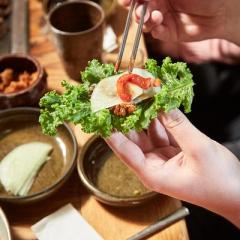
Who does the grilling depends on the restaurant. In neighborhood places you cook it yourself. In mid-range and premium restaurants the staff often start the meat, turn it and cut it for you, and in either kind it is normal to ask for help. The meat is eaten as ssam: a leaf in the palm, a piece of meat, a slice of garlic or pepper, a dab of ssamjang, folded and eaten in one bite.
The meal usually ends with a starch. Rice, a soybean-paste stew, cold buckwheat noodles or rice fried on the grill plate are ordered separately once the meat is mostly gone. In many restaurants you pay at the counter on the way out, and you do not tip.
❓ Do you cook the meat yourself at Korean BBQ in Seoul?
It depends on the restaurant. At neighborhood barbecue places you grill it yourself with the tongs and scissors the staff bring. At mid-range and premium restaurants the staff often start the meat, turn it and cut it for you. In both kinds it is normal to ask for help, and first-time visitors do.
The trade-off: the format that makes barbecue fun for four is the one that makes it awkward for one. Everything about the table, the grill, the shared leaves and the portions, assumes a group.
The Two-Portion Rule: Korean BBQ’s Minimum Order
The rule that surprises visitors most is the minimum. Most Korean barbecue restaurants require at least two portions per table, and it applies whether two people sit down or one. The logic is the table itself: a grill has to be lit, set with side dishes and cleaned afterward, and a single portion does not pay for that.
How strictly it is applied varies. Many restaurants will seat one person who orders two portions. Some will not seat a single diner at all, especially at the dinner rush. Ask before you sit down.
The portion has also been getting smaller. The official price surveys count a portion of pork belly as 200 grams, but Korean press reports describe restaurants now selling portions of 150 to 180 grams, which keeps the price on the menu under ₩20,000. Two portions is therefore less meat than it sounds: about 300 to 360 grams before cooking.
❓ Is there a minimum order at Korean BBQ in Seoul?
Usually, yes. Most Korean barbecue restaurants require at least two portions of meat per table, written 2인분, whether one person or two sit down. Many will seat a solo diner who orders two portions, and some will not seat one person at all at busy hours. Ask at the door before you sit down.
The trade-off: two portions is roughly right for one hungry person and too much for a light eater. Either way you pay for both, and a menu portion today is smaller than the 200 grams the price statistics assume.
What Korean BBQ Costs in Seoul
Pork belly, samgyeopsal, is the benchmark, because the Korea Consumer Agency tracks its restaurant price every month. The Seoul average for a 200-gram portion passed ₩20,000 in 2024 and stood at about ₩21,300 in the agency’s August 2026 survey.
| 💵 What you are buying | Typical range in Seoul |
|---|
| 🥓 Pork belly (samgyeopsal), one menu portion of 150–180 g | about ₩15,000–20,000 |
| 📊 Official Seoul average for pork belly, converted to 200 g | about ₩21,300 (consumer agency survey, August 2026) |
| 👥 Pork belly dinner for two, with rice or stew and drinks | about ₩50,000–80,000 |
| ♾️ All-you-can-eat barbecue | about ₩18,000–30,000 per person |
| 🐄 Hanwoo, the premium Korean beef | from about ₩40,000 per 100–150 g, and far higher for top cuts |
The official figure and the menu do not match, and the gap is the portion size. The survey converts every restaurant’s price to 200 grams, while the menu sells 150 to 180. So a menu that says ₩16,000 or ₩18,000 can cost more per gram than one that says ₩20,000. Compare the grams, not the price of a portion.
For the whole meal, a pork belly dinner for two with a stew or rice and a couple of drinks lands at roughly ₩50,000 to ₩80,000. Beef changes the scale. Hanwoo, the domestic breed that Korean diners treat as the premium choice, starts at about ₩40,000 for a portion of 100 to 150 grams and climbs far higher for the best cuts.
❓ How much does Korean BBQ cost per person in Seoul?
For pork belly at an ordinary restaurant, plan on roughly ₩25,000 to ₩40,000 per person including rice or stew and a drink, with menu portions of 150 to 180 grams priced at about ₩15,000 to ₩20,000 each. All-you-can-eat places run about ₩18,000 to ₩30,000 per person. Hanwoo beef starts at about ₩40,000 for a single small portion and rises steeply.
The trade-off: pork belly is the most expensive of the everyday dishes the agency tracks, ahead of ginseng chicken soup and cold noodles. And the number on the menu misleads, because a portion is not a fixed size.
Eating Korean BBQ Alone in Seoul
Eating alone is ordinary in Seoul. More than a third of South Korean households are a single person, there is a word for the solo meal, honbap, and noodle shops, rice-soup restaurants and lunch counters seat one without a second look. Barbecue is the exception, and the reason is the two-portion rule, not disapproval.
| 🧍 If you are on your own | What it costs you |
|---|
| 🟢 Order two portions at an ordinary restaurant | You pay for two; most places will then seat you |
| 🟢 Find a solo-barbecue counter (look for 1인 가능 or 혼밥) | One portion, one seat; they are a minority and take finding |
| 🟡 Go off-peak, mid-afternoon or late | Nothing extra; a quiet restaurant is likelier to say yes |
| 🟡 Join a food tour with a barbecue stop | The tour price; the group shares the grill |
| 🔴 Walk into a busy restaurant at 7 pm and ask for one portion | Expect to be turned away |
The simplest route is to order two portions and say so as you walk in. A second is the solo-barbecue counter: a row of single seats, each with its own small grill, often ordered from a tablet. They exist in Seoul and they are a minority, so they take some finding. The signs to look for are 1인 가능, one person welcome, and 혼밥, solo meal.
The third is to stop being one. Several evening food tours in Seoul include a barbecue stop, which puts a solo traveler at a shared grill with a guide who orders and explains. It costs more than dinner alone would, and it turns the one Korean meal that resists a single diner into the easiest one of the trip.
❓ Can you eat Korean BBQ alone in Seoul?
Yes, with one of three approaches. Order two portions at an ordinary restaurant, which most will accept outside the busiest hours. Look for a solo-barbecue counter with single-seat grills, signed 1인 가능 or 혼밥. Or join a food tour that includes a barbecue stop and share the grill with the group. What rarely works is asking a busy restaurant for one portion.
The trade-off: the solo counter gives you one portion at one seat and takes away the long, shared table that the meal is known for. Ordering for two at a regular restaurant keeps the setting and doubles the bill.
All-You-Can-Eat Korean BBQ: When It Makes Sense
All-you-can-eat barbecue is a category of its own in Seoul, marked 무한리필, unlimited refill. You pay a flat price per person, about ₩18,000 to ₩30,000, and take meat until a time limit runs out. Ninety minutes to two hours is typical. Check the house rules before you start.
The arithmetic is simple. With a menu portion at ₩15,000 to ₩20,000, the flat price is covered by the second portion. For a group that wants volume, it is usually the cheapest way to eat barbecue in the city. Ask about solo diners before sitting down: a per-person price does not always mean one person is welcome.
❓ Is all-you-can-eat Korean BBQ worth it in Seoul?
On price, yes, if you would eat two portions or more: the flat rate of about ₩18,000 to ₩30,000 per person is covered by the second portion at an ordinary restaurant. Expect a time limit of roughly ninety minutes to two hours. It is built for volume rather than for one particular cut.
The trade-off: all-you-can-eat is priced for quantity. If the point of the dinner is one particular cut, or a restaurant known for it, order by the portion.
Pork, Beef, and a Vegetarian at the Table
Three names cover most menus. Samgyeopsal is pork belly, the everyday order. Galbi is ribs, pork or beef, usually marinated. Hanwoo is beef from the Korean native breed, sold by the cut at premium prices and often the reason for a special dinner. A first visit that orders pork belly and one other cut has seen what the meal is.
A vegetarian at a barbecue table has less to eat than the spread suggests.
Kimchi is usually made with fish sauce or salted shrimp, the stews are commonly built on anchovy or meat stock, and mushrooms and vegetables go on the same grill as the meat. Steamed egg is vegetarian and not
vegan. Rice, plain leaves and some of the vegetable side dishes are safe ground, and it is worth asking what is in the rest.
❓ What can a vegetarian eat at a Korean BBQ restaurant?
Less than the number of dishes suggests. Rice, lettuce and perilla leaves and some vegetable side dishes are fine, and steamed egg is vegetarian though not vegan. Kimchi usually contains fish sauce or salted shrimp, stews are commonly made with anchovy or meat stock, and mushrooms and vegetables are cooked on the same grill as the meat. Ask what is in each dish.
The trade-off: a barbecue restaurant will feed a
vegetarian companion and will not give them a meal. If one of you does not eat meat, treat it as the meat-eater’s dinner and plan the other one elsewhere.
Prices, portion sizes and house rules reflect information checked in October 2026 and vary by restaurant, neighborhood and cut. The official average quoted is the Korea Consumer Agency survey figure for Seoul; individual menus differ. Minimum orders, solo seating, time limits and what a dish contains are set by each restaurant, so confirm them on the day, and ask about ingredients if you have an allergy or dietary restriction.



 Jongno-gu Night Food Walk with Korean BBQ$96
 Insadong Night BBQ & Rice Wine Food Crawl$110
 Seoul Night Market, BBQ & Tea House Food Walk$140